

Global Cosmetic Jars Market to Reach USD 5.4 Billion by 2035, Asia Pacific Leads, Aptar Group and Gerresheimer AG Expand
Cosmetic Jars Market Size
Cosmetic jars in Germany is growing at a 6.2% CAGR, driven by skincare demand, precision manufacturing, and high-performance barrier packaging innovation.
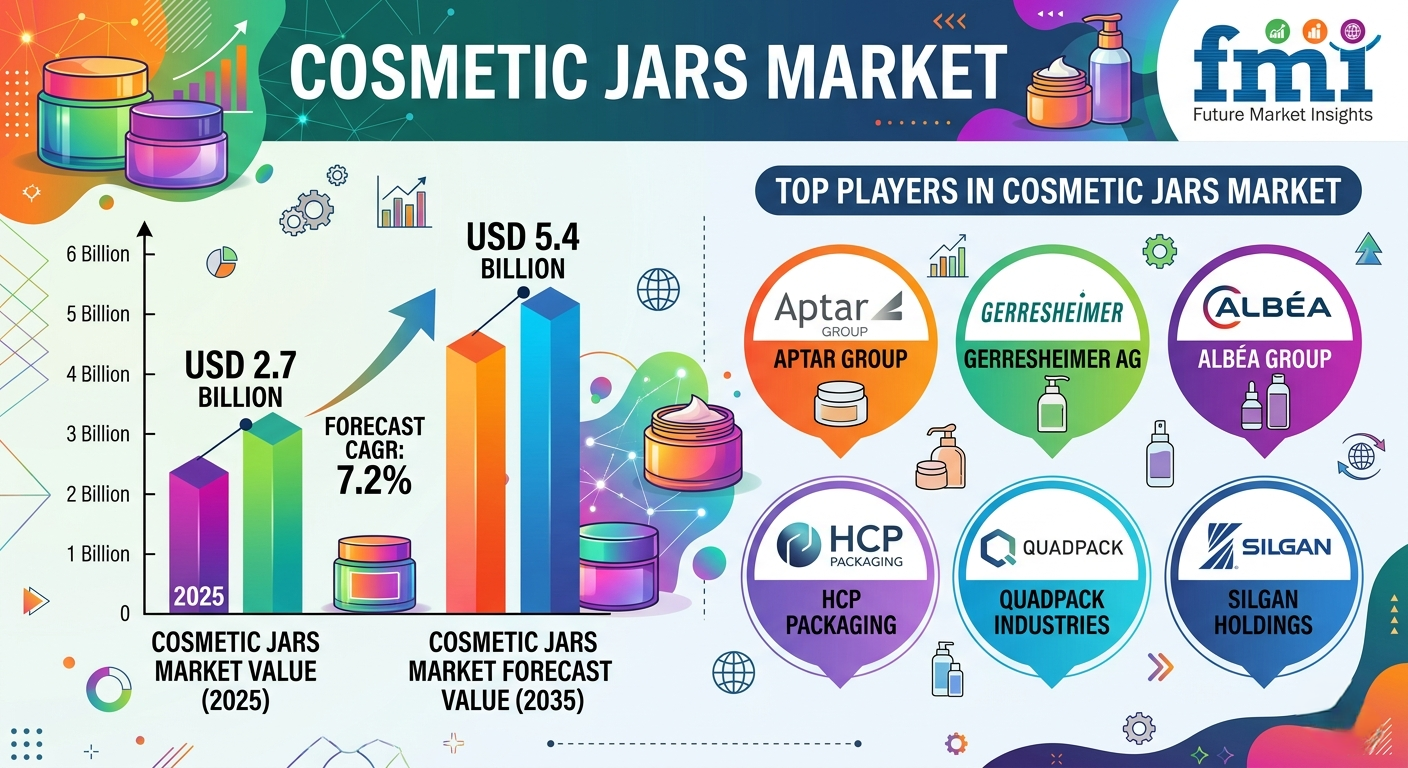
NEWARK, DE, UNITED STATES, April 1, 2026 /EINPresswire.com/ -- The global cosmetic jars market is entering a transformative decade, evolving from a functional packaging category into a strategic pillar of premium beauty branding and formulation protection. Valued at USD 2.7 billion in 2025, the market is projected to reach USD 5.4 billion by 2035, expanding at a robust CAGR of 7.2%.
This growth is being fueled by a convergence of high-impact industry trends: the global surge in premium skincare consumption, the rapid adoption of airless packaging technologies for sensitive formulations, and a growing emphasis on aesthetic differentiation across luxury beauty segments. Cosmetic jars are no longer simple containers—they are becoming essential enablers of product performance, shelf appeal, and brand storytelling.
Request Your Sample Now – Unlock Growth Potential and Discover Key Market Opportunities!
https://www.futuremarketinsights.com/reports/sample/rep-gb-14618
The Packaging Evolution: From Storage to Strategic Differentiation
The cosmetic jars market is undergoing a material and technological shift. What was once dominated by basic storage functionality is now defined by advanced barrier performance, tactile luxury, and precision engineering.
Manufacturers are investing heavily in innovations such as air-tight sealing systems, double-walled constructions, UV-protective coatings, and precision-thread closures. These advancements are critical for preserving oxygen-sensitive formulations such as retinol creams, vitamin C serums, and peptide-based anti-aging products.
“Packaging is no longer secondary in beauty—it’s central to performance and perception,” notes an industry analyst. “Brands that deliver both formulation integrity and premium user experience through packaging are commanding higher margins and stronger consumer loyalty.”
Material Innovation: Balancing Performance, Cost, and Sustainability
Plastic jars—including PET, PP, and HDPE—continue to dominate the market, accounting for 59% of total share in 2025. Their lightweight nature, cost efficiency, and design flexibility make them indispensable for mass-market and high-volume applications.
However, the premium segment is witnessing a strong shift toward glass jars, driven by rising demand for sustainable, recyclable, and chemically inert materials. Glass packaging is increasingly associated with clean beauty, organic formulations, and luxury positioning.
At the same time, manufacturers are enhancing plastic jars with barrier coatings and premium surface finishes, enabling them to compete in higher-value segments while maintaining economic efficiency.
Skincare Dominance: The Core Demand Engine
Skincare applications remain the backbone of the cosmetic jars market, accounting for 51% of total demand. Products such as moisturizers, anti-aging creams, body butters, exfoliating masks, and therapeutic balms rely heavily on jar packaging due to their thick textures and need for controlled dispensing.
As global consumers invest more in skincare—particularly in anti-aging and dermatological solutions—the demand for packaging that ensures product stability, contamination resistance, and premium presentation continues to rise.
Jars also offer a distinct advantage in delivering a luxurious tactile experience, reinforcing brand perception in high-end retail and e-commerce environments.
E-Commerce and Indie Brands Reshape Demand Patterns
The rapid expansion of e-commerce and direct-to-consumer beauty brands is reshaping packaging requirements. Smaller, indie brands are driving demand for low minimum order quantities (MOQs), customizable designs, and visually distinctive packaging.
This shift is encouraging manufacturers to offer modular designs, flexible production capabilities, and rapid prototyping, enabling faster go-to-market strategies for emerging beauty players.
Additionally, the rise of subscription boxes, travel-sized products, and sample kits is accelerating demand for compact, leak-proof, and aesthetically appealing jar formats.
Opportunity Pathways: High-Value Growth Segments
The cosmetic jars market presents multiple high-growth opportunity pathways across innovation and regional expansion:
• Airless Jar Technologies: Designed for oxygen-sensitive formulations, these systems offer complete product evacuation and extended shelf life, creating a premium revenue pool of up to USD 850 million.
• Glass Jars for Natural Cosmetics: Demand for recyclable and visually premium packaging is unlocking opportunities worth up to USD 720 million.
• Refillable & Modular Systems: Sustainability-driven designs with interchangeable components are enhancing brand loyalty and generating strong margin uplift.
• Travel-Sized & Sample Packaging: Compact formats tailored for mobility and trial usage are expanding market reach across hospitality and retail channels.
• UV-Protected & Barrier-Enhanced Jars: Advanced coatings for ingredient preservation are gaining traction in high-performance skincare.
• Smart Packaging Integration: NFC chips, QR codes, and authentication technologies are emerging as key differentiators in combating counterfeiting and enhancing consumer engagement.
Regional Insights: Asia-Pacific Leads Global Momentum
The Asia-Pacific region is at the forefront of market expansion, driven by high beauty consumption and innovation ecosystems:
• South Korea (9.7% CAGR): A global leader in K-beauty innovation, driving demand for advanced packaging designs and premium aesthetics.
• China (8.3% CAGR): Rapid growth in luxury cosmetics and domestic beauty brands is fueling demand for high-end jar solutions.
• Japan (6.4% CAGR): Precision manufacturing and minimalist design philosophy are shaping premium packaging trends.
Meanwhile, North America and Europe continue to demonstrate steady growth, supported by clean beauty trends, refillable packaging innovations, and strong purchasing power.
• United States (6.8% CAGR): Focus on personalized skincare and sustainable packaging solutions.
• France (7.1% CAGR): Luxury heritage and perfume house expansion into skincare drive demand for artisanal packaging.
• Germany (6.2% CAGR): Pharmaceutical-grade packaging and dermo-cosmetics create demand for high-performance jars.
Sustainability and Smart Packaging: Defining the Next Decade
Looking toward 2035, sustainability and technology integration will redefine competitive dynamics:
• Eco-Friendly Materials: Increased adoption of recyclable glass, biodegradable plastics, and reduced packaging waste.
• Refillable Systems: Modular designs enabling reuse and waste reduction, particularly in luxury segments.
• Smart Authentication: Integration of digital technologies to ensure product authenticity and enhance consumer trust.
• Advanced Decoration: Techniques such as UV lacquering, embossing, metallization, and matte finishes enabling unique brand identities.
These trends are aligning packaging with broader consumer expectations סביב sustainability, transparency, and premium experiences.
Competitive Landscape: Innovation as the Differentiator
The cosmetic jars market is highly competitive, with leading players focusing on technology integration, customization, and sustainability-driven innovation.
Key companies include:
• Aptar Group
• Gerresheimer AG
• Albéa Group
• HCP Packaging
• Quadpack Industries
• Silgan Holdings Inc.
These companies are investing in airless dispensing systems, premium glass manufacturing, advanced decoration techniques, and refillable packaging solutions to strengthen their market position.
Strategic initiatives such as vertical integration, regional manufacturing expansion, and partnerships with beauty brands are further enhancing competitiveness.
Why FMI: https://www.futuremarketinsights.com/why-fmi
Explore More Research Reports by FMI
Tamper-Evidence & Anti-Counterfeit Packaging Features for High-Value DPP-Tagged Packs Market - https://www.futuremarketinsights.com/reports/tamper-evidence-and-anti-counterfeit-packaging-features-for-high-value-dpp-tagged-packs-market
Paper Wrap Market - https://www.futuremarketinsights.com/reports/paper-wrap-market
Plant-Based Shrink Wrap Market - https://www.futuremarketinsights.com/reports/plant-based-shrink-wrap-market
Protein-matrix Lining Market - https://www.futuremarketinsights.com/reports/protein-matrix-lining-market
E-Grocery Compostable Delivery Bags Market - https://www.futuremarketinsights.com/reports/e-grocery-compostable-delivery-bags-market
About Future Market Insights (FMI)
Future Market Insights, Inc. (FMI) is an ESOMAR-certified, ISO 9001:2015 market research and consulting organization, trusted by Fortune 500 clients and global enterprises. With operations in the U.S., UK, India, and Dubai, FMI provides data-backed insights and strategic intelligence across 30+ industries and 1200 markets worldwide.
Sudip Saha
Future Market Insights Inc.
+1 347-918-3531
rahul.singh@futuremarketinsights.com
Legal Disclaimer:
EIN Presswire provides this news content "as is" without warranty of any kind. We do not accept any responsibility or liability for the accuracy, content, images, videos, licenses, completeness, legality, or reliability of the information contained in this article. If you have any complaints or copyright issues related to this article, kindly contact the author above.
