

The USD 24.4 Billion Connection: Global EV Charging Cable Market Set for 22.2% Annual Surge Through 2036
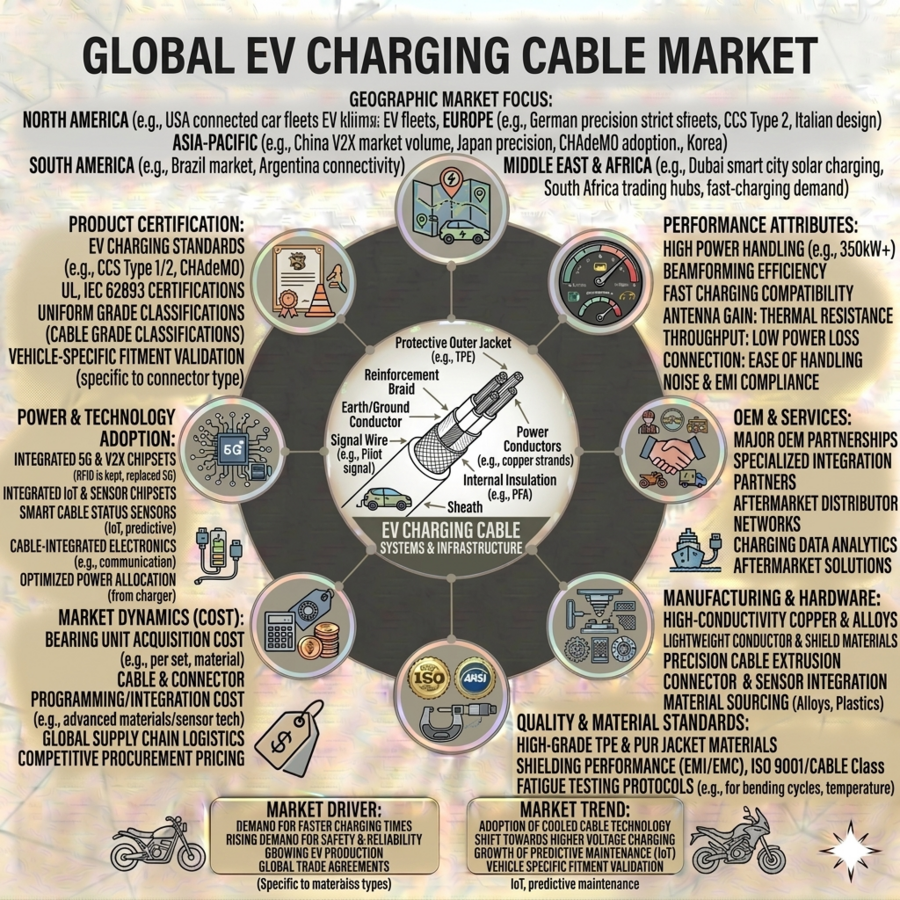
EV Charging Cable Market
Demand is estimated to grow to USD 3.3 billion in 2026 and USD 24.4 billion by 2036. FMI projects a CAGR of 22.2% during the forecast period.
NEWARK, DE, UNITED STATES, April 1, 2026 /EINPresswire.com/ -- As the global automotive industry undergoes a fundamental structural reset, the literal "umbilical cord" of the electric transition is moving from a commodity hardware product to a high-tech center of innovation. According to the latest strategic analysis from Future Market Insights (FMI), the Global EV Charging Cable Market is valued at USD 3.3 billion in 2026 and is projected to explode to USD 24.4 billion by 2036, expanding at a massive CAGR of 22.2%.
This decade-long growth trajectory is being dictated by a global de-carbonization mandate that is forcing a shift from passive copper cords to active, "smart" connectivity systems. The first half of this forecast period will be defined by the rapid deployment of residential infrastructure, while the latter half will see a surge in high-capacity, liquid-cooled cables capable of supporting the next generation of 350 kW+ ultra-rapid charging protocols.
The "Safety Premium": Why the Value Pool is Shifting
The industry is moving beyond simple electricity delivery. Nikhil Kaitwade, Principal Consultant at Future Market Insights, notes that a "Safety Premium" is emerging in the market. Cables integrated with advanced thermal sensors, vehicle-to-grid (V2G) communication chips, and high-performance polymers are commanding significantly higher margins than standard cords.
As charging speeds increase, the thermal load on the cable becomes the primary engineering bottleneck. To combat this, the market is pivoting toward active thermal management. While standard AC cables remain the high-volume staple for home use, the high-value growth is found in cables that utilize liquid cooling to manage 1,000+ Amp charging events—essential for the electrification of heavy-duty Class 8 logistics fleets and long-haul trucking.
Get Access of Report Sample:
https://www.futuremarketinsights.com/reports/sample/rep-gb-13262
Segment Dominance: The "Sweet Spot" of Fast Charging
In 2026, the market is characterized by a "one-car-one-cable" dynamic that ensures private charging remains the primary volume driver. AC Charging cables currently hold a 92.0% market share, largely because they align with the existing electrical infrastructure of millions of homes and workplaces globally.
However, the Fast Charging (7–22 kW) segment has emerged as the "Sweet Spot" for commercial and destination charging, accounting for 50.0% of demand.
This power band perfectly matches the "dwell time" of drivers at hotels, retail centers, and offices, providing meaningful range gains without requiring the massive infrastructure investment of DC fast chargers. Meanwhile, the Mode 3 safety protocol has become the mandatory standard for public AC infrastructure, ensuring continuous communication between the car and the grid to prevent overheating and electrical faults.
The Standard War: Type 2 vs. NACS
The connector landscape remains a battleground of regional standards. The Type 2 (Mennekes) connector continues to lead global volumes (excluding China), supported by its universal adoption in Europe, India, and Australia. Its ability to handle both single-phase and three-phase power gives it a technical edge in the 230V world.
In North America, the shift toward the North American Charging Standard (NACS) is consolidating the market, while China’s GB/T standard allows domestic manufacturers to achieve unprecedented economies of scale. For global suppliers, the challenge—and opportunity—lies in maintaining multiple SKU lines while innovating in lightweight materials to reduce cable weight by up to 30% for better user ergonomics.
Regional Powerhouses: India and Germany Lead Growth
The geography of the EV charging cable market is a map of aggressive government policy and infrastructure investment.
• India (35.4% CAGR): India is the world’s fastest-growing market, propelled by the FAME II scheme and new mandates requiring 20% of parking in new residential buildings to be EV-ready.
• Germany (29.6% CAGR): As the heart of European automotive manufacturing, Germany is leading the deployment of High-Power Charging (HPC) networks along the Autobahn, driving the demand for specialized liquid-cooled solutions.
• United States (24.5% CAGR): Growth is bolstered by the National Electric Vehicle Infrastructure (NEVI) program, which is funding a comprehensive coast-to-coast charging grid along interstate corridors.
• Japan (29.2% CAGR): Japan is carving out a niche in Vehicle-to-Home (V2H) technology, where cables must be bidirectional to allow EVs to act as backup power sources during grid outages.
Competitive Outlook: Innovation Over Price
The market is no longer a simple price war. Top-tier players like TE Connectivity, Phoenix Contact, and Aptiv are competing on reliability and certification. Recent developments highlight this shift: Phoenix Contact recently launched 375 kW continuous power cables, while Prysmian has introduced sustainable jackets made from recycled materials to meet the circular economy goals of European OEMs.
As Tesla continues to vertically integrate its charging ecosystem, independent suppliers are doubling down on R&D for "Smart Cables" that support ISO 15118 communication—the prerequisite for "Plug & Charge" features where the car and cable communicate to handle billing automatically without an app or card.
Frequently Asked Questions (FAQ)
1. Why are most EV cables straight rather than coiled like old telephone cords?
Straight cables are generally preferred because they have better thermal stability under high current loads. Coiled cables have a "memory" effect that makes them harder to stretch to their full length, and they can trap heat more easily when bunched together.
2. What is the difference between a Mode 2 and a Mode 3 cable?
Mode 2 cables are "portable" chargers that plug into a standard household outlet and have a bulky control box on the cord. Mode 3 cables are designed for dedicated wallboxes or public charging stations; they are safer, faster, and support smart communication with the grid.
3. Does the length of the cable affect charging speed?
Generally, no, but longer cables (beyond 5 meters) are significantly heavier and more expensive because they require thicker copper internal wiring to prevent voltage drop and heat buildup over the distance.
4. Are EV charging cables waterproof?
Yes, high-quality cables from reputable manufacturers are designed to be weather-resistant (typically IP54 or higher). However, they should never be submerged in water, and the connector "pins" should be kept dry when not in use.
5. Why is liquid cooling necessary for some cables?
When you push 350 kW or more through a cable, the electrical resistance generates massive amounts of heat. Without liquid cooling, the copper would have to be so thick that the cable would be too heavy for a human to lift. Cooling allows the cable to stay slim and manageable.
Browse More Industry Reports :
EV Charging Cable Locks and Security Devices Market
https://www.futuremarketinsights.com/reports/ev-charging-cable-locks-and-security-devices-market
EV Charging Cable Management Accessories Market
https://www.futuremarketinsights.com/reports/ev-charging-cable-management-accessories-market
EV Charging As A Service Market
https://www.futuremarketinsights.com/reports/ev-charging-as-a-service-market
Sudip Saha
Future Market Insights Inc.
+1 347-918-3531
email us here
Legal Disclaimer:
EIN Presswire provides this news content "as is" without warranty of any kind. We do not accept any responsibility or liability for the accuracy, content, images, videos, licenses, completeness, legality, or reliability of the information contained in this article. If you have any complaints or copyright issues related to this article, kindly contact the author above.
